
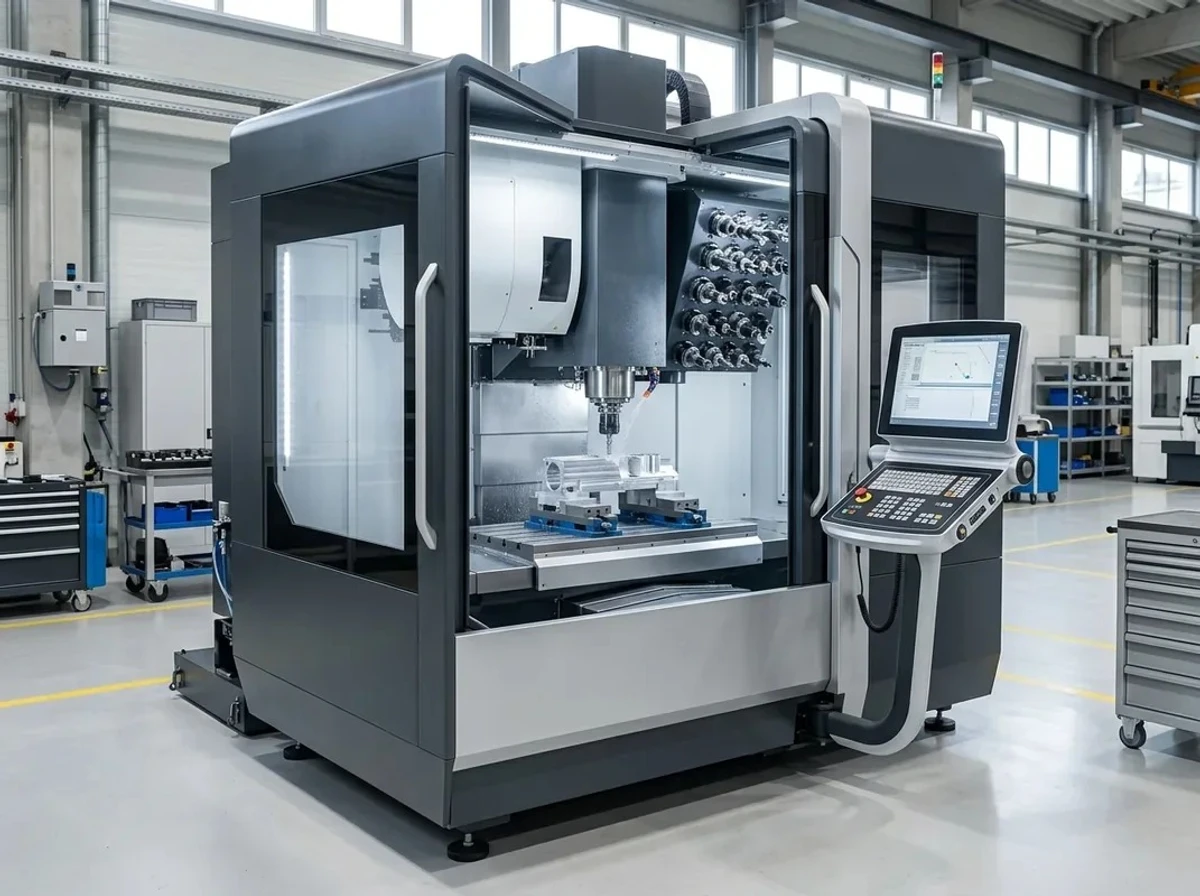
The 850-size Vertical Machining Center (VMC) is universally acknowledged as the most versatile, high-demand machine tool size in metalworking. With an 800 × 500 mm nominal travel envelope, it strikes the perfect balance between footprint, workpiece capacity, and high-speed cutting efficiency.
However, machine specifications on paper can be deceptive. Two machines marketed under the “VMC850” designation can differ by thousands of kilograms in mass, tens of thousands of dollars in component quality, and an order of magnitude in geometric accuracy retention over time.
This guide provides a rigorous engineering checklist to ensure you invest in a machine that maintains sub-micron precision for years to come.
1. Casting Grade & Structural Ribbing Architecture
The foundation of any vertical machining center is its iron casting. The casting determines vibration absorption, dynamic rigidity, and long-term thermal stability.
+-------------------------------------------------------------------------------+
| CRITICAL CASTING PARAMETERS TO DEMAND FROM YOUR SUPPLIER                      |
+-------------------------------------------------------------------------------+
| Cast Iron Grade       | HT300 / Meehanite Resin-Sand Casting (Tensile ≥ 300 MPa) |
| Aging Treatment       | Dual Annealing Cycle: Thermal Stress Relief + 6 Months Natural Seasoning |
| Column Base Width     | ≥ 820 mm Wide-Span Triangular Symmetrical Column       |
| Total Machine Weight  | Standard Duty: ≥ 4,800 kg | Heavy Duty: ≥ 5,200 kg     |
+-------------------------------------------------------------------------------+
The Danger of Lightweight Castings
Low-cost VMC850 machines often weigh less than 3,800 kg. Manufacturers cut costs by using thin-walled HT200 gray iron and reducing internal diagonal cross-ribbing.
- Under heavy end-milling or deep cavity roughing, thin column walls resonate, producing high-frequency chatter marks that ruin surface finishes and rapidly chip carbide cutting inserts.
- Qingluan VMC850 machines weigh over 5,200 kg, utilizing dense HT300 Meehanite castings that naturally dampen cutting harmonics and maintain bedway geometry over decades of heavy production.
2. Spindle Selection: Belt Drive vs. Direct Drive vs. Built-in Spindle
The spindle is the heart of the machining center. Choosing the wrong spindle type results in either premature bearing failure or insufficient cutting torque.
| Spindle Type | Speed Range | Power Transmission | Best Applications | Maintenance Considerations |
|---|---|---|---|---|
| High-Torque Belt Drive | 6,000 – 8,000 RPM | Timing belt with 1:1 or 1:2 ratio pulleys | Heavy roughing, steel die blocks, titanium, large face mills | Periodic belt tension checks; high torque at low RPMs |
| Direct-Drive (In-Line) | 10,000 – 15,000 RPM | Precision flexible coupling directly connecting motor to spindle | High-speed aluminum milling, mold finishing, precision 3D profiling | Zero belt vibration; minimal thermal growth; requires chiller |
| Built-in Motor Spindle | 18,000 – 24,000+ RPM | Rotor integrated directly into the spindle cartridge | Aerospace micro-milling, graphite electrode machining | Requires dedicated refrigerated liquid cooling and high-pressure air seal |
Recommended Configuration
- For general machining and mixed job shops: An 8,000 or 10,000 RPM BT40 direct-drive or belt-drive spindle powered by an 11 kW main motor provides the ideal blend of low-end torque for tapping steel and high-end RPM for contouring aluminum.
- For precision tool and mold making: Select a 12,000 RPM direct-drive spindle equipped with an external refrigerated oil chiller to maintain thermal stability during uninterrupted 18-hour 3D finishing passes.
3. Guideways: Ball Linear Guides vs. Roller Linear Guides vs. Box Ways
Guideway selection dictates how cutting loads are supported across the X, Y, and Z axes.
- Roller Linear Guideways (Qingluan Standard): Utilize cylindrical rollers instead of spherical ball bearings. Rollers provide line contact rather than point contact, delivering twice the dynamic load capacity and dampening rigidity of ball guides while maintaining 24–36 m/min rapid traverse speeds.
- Hardened Box Ways (Solid Slideways): Excellent for extreme low-speed heavy peeling of forged blocks, but limited to 12–16 m/min rapid traverse and prone to stick-slip friction over long cycles.
4. Measuring Accuracy: Pitch Error Compensation & Ballbar Tests
Before accepting delivery of any VMC850, require the manufacturer to provide certified test records conducted with international measurement instruments:
- Renishaw Laser Interferometer Pitch Calibration: Verifies positioning accuracy and repeatability across the entire travel stroke of each axis, compensating for thermal expansion and mechanical lead-screw pitch variations.
- Renishaw QC20-W Ballbar Circularity Test: Measures dynamic servo tracking synchronization, squareness between X and Y axes, and reversal backlash spikes during high-speed circular interpolation.
- Spindle Taper Runout Test: Spindle nose runout must measure ≤ 0.003 mm, and runout at a 300 mm test bar tip must measure ≤ 0.008 mm.
5. Factory Direct Sourcing Checklist
When ordering your VMC850 direct from Qingluan Precision Machinery, standard factory equipment includes:
- Full CE Certification with safety interlock doors and electrical cabinet compliance
- Dual-circuit high-pressure coolant pump with bedway washdown nozzles
- Automatic centralized volumetric lubrication pump with low-level alarm
- 24-pocket high-speed arm-type tool changer with bi-directional tool search
- Factory pre-wiring for 4th-axis rotary table installation
- Full sea-freight export packaging with anti-rust vapor corrosion inhibitor (VCI) shrink wrapping and reinforced steel base skid
Request a Custom Specification & Quotation
Need custom travel dimensions, high-pressure through-spindle coolant (CTS 20/30/70 bar), or optical linear glass scales? Contact our technical sales desk at [email protected].